Saturday, 15 July 2017

Happy 3rd Birthday World Peace Is None Of Your Business

I've been musing over this piece for the past week or so, and I'm so excited I don't even know where to begin!
How can I possibly open my article (I don't really like the word blog - it's a bit ugly) eloquently enough to do justice to this album?
Me, sitting here at my keyboard, in the humdrum heat of summer, with 8-legged companion Moogly the 2nd (as Moogly numero uno has since moved on) hanging out on my window-sill...

I thought about dragging you all back to 2014 and droning on about how I felt like a misfit at a family wedding: I was half-drowning in a sea of "what are you doing with your life" questions and clutching the edge of the bar as if it were a life preserver. (By the way, weddings at cideries are trouble, in case you were wondering).
Ugh. No one wants to hear that story.

The far more important fact about 2014 is that it was the year World Peace Is None Of Your Business was released. Yes, 31 years after the Smiths released Hand In Glove - I had only just discovered Moz... although back in 1983, I probably wasn't precocious enough - I think I only owned Barbie on vinyl... However, how Moz could have helped Oscar-Wilde-obsessed teenage me in the 90's, or disenchanted-young adult me in the 00's, I'll never know.


So all I can do is return to 2014, and think of how I am seated at this wedding in the middle of a sweltering orchard, corseted into a blue lace dress, silently giggling to myself that Morrissey has written a song called Kick The Bride Down The Aisle. Formal social situations perpetually seem to provoke anxiety, so it's strangely comforting, and feels a bit like Morrissey is whispering an inside joke in my ear, or... almost holding my hand (I wish). But in some sense he's here - and he's helping.
...And in doing so... he helps me feel more comfortable, because I am not alone in my dissatisfaction with certain aspects of existence. What makes his art so real, is that he is a human being with an opinion - and more than that, he isn't afraid to speak his mind, and sing his life.

World Peace Is None Of Your Business was the album we needed in 2014. And now, a few years later, I think we need it even more than ever. 

What does the 21st century look like to you?
What is being made 'great' again?
Was anything ever 'great'?

Are we, collective we, languishing under blundering, bullyish governments most of us never asked for, moving forward, or learning anything about ourselves, each other, our planet?

Or are we simply tacitly paying our taxes, trudging along begrudgingly, shackled to our daily lives of drudgery – because we aren’t sure what else to do?

As we know, Morrissey is anything but a crashing bore - so he - in all his musical and lyrical glory, asks us to confront the uncomfortable.


Morrissey at SXSW in 2006

In a 2006 interview for SXSW, Morrissey said he cannot bear the expression "lowest common denominator" and that it's tremendously unfortunate most modern pop music caters to such a notion; the world could change if we simply assume "everybody's extremely intelligent."

What's disturbing is I don't think it would be incorrect to consider the pop music industry a microcosm for nearly every other aspect of modern life: 
How often are we spoken down to by politicians, bosses, tv commercials, the news, our professors, our families? ... the list goes on...

With World Peace Is None Of Your Business, it's clear that Morrissey is singing to his audience as though we are a highly intelligent group of people. Covering topics ranging from politics, to animal rights, to gender roles, to mortality - his thought provoking, hope-and-despair driven lyrics weave seamlessly with genre-bending instrumental tapestries, and for the 55:00 min run time (longer if you count the bonus track edition, which is a work of art in itself) - there is never a dull moment.

I wanted to focus on my own experience with the album, so to start I simply listened and scribbled down whatever nestled its way into my scattered mind. For this reason, I generally decided to avoid reading the majority of professional magazine or internet reviews, but I did read some 2014 interviews with Morrissey to gain perspective. We approach music with our own ears and experience, and I believe in this sense our relation to art is very personal, so here goes...


World Peace Is None Of Your Business

The title track opens the album with the root shaking rumble of a digeridoo, soon joined by pulsating percussive pounds, together giving birth to an earthy heartbeat. QChord chords descend into Morrissey's smooth vocals: 

World peace is none of your business
You must not tamper with arrangements
Work hard and sweetly pay your taxes
Never asking what for
Oh, you poor little fool, oh, you fool.

He's captured my attention: who is he calling a fool? He's empathetic about our collective situation - but he's also bristled us a bit - are we truly "poor little fools," toiling under boring jobs and badly-coiffed authority, being taxed, yet numbly never questioning the nature of this system? In the first verse on the opening song of his album, Morrissey already has us looking inwards and outwards, questioning the state of ourselves and our world.

What strikes me so about Morrissey's vocals - and it really stood out to me with this song - is that he is able to capture a multidimensional mosaic of emotions extending well beyond primary emotions. His voice is not merely happy, or sad, or angry... rather, he succeeds in conveying a multifaceted blend of pity, teasing, empathy, disappointment, concern - and then towards the climax of the song... his tone shifts to defiance and empowerment, as he switches the line to, "No more, you poor little fool." I think of these as emotional subtones, or shades (a common example of emotional complexity we experience is "bittersweet"); Morrissey phrases and tones his singing to convey affective layers as an artist might combine brush strokes, shadows, and light to create complex mood in a painting.

Next track up is beat-poetry infused Neal Cassady Drops Dead, howling and growling with a conversation between aggressive crunching guitars and echoing drumbeats. Like any good slam poet knows, the rests are nearly as important as the notes, and instrumental rhythms, combined with Morrissey's musings over Allen Ginsberg's response to Cassady's death, throw us into the shock of the moment.


Ginsberg with Cassady, 1955. Photo by Natalie Jackson


While I had heard of Ginsberg, Neal Cassady was new to me, and Cassady had such a fascinating life story it's tempting to get into some detail here. A contemporary and lover of Ginsberg's, Cassady was also a beat poet, and was name-checked in Ginsberg's beat-gen masterpiece, Howl. Cassady's ecstatic, indulgent nights of drug use fuelled inspiration, but did not exactly sync-up well with his family life, wife, and children. Balancing an imbalanced tightrope walk between two lives he had trouble merging, Cassady drank and drugged heavily. The glare of fame also weighed on his frame, and Cassady dropped dead at the age of 41, of somewhat uncertain causes, at the side of a railroad track. 

The song's dramatic tension is traced with well-placed droplets of humour - at least I think so - with the image of tears shampooing Ginsberg's beard time fusing 21st century hipsters with 1950's beats for musical eternity. Neal Cassady then segues into deliciously germ-conscious free-style rhyme, where Moz laments "Everyone has babies, Babies full of rabies..."; the entire segment showcases his linguistic dexterity. Admittedly, due to my current cacophonous renting situation: living below scatterbrained landlords and their 4 screeching rug rats, I delight scrumptiously in the "get that thing away from me" line.

Sorrowful strings and effects evocative of helicopter chops slice into skillful flamenco guitar and the song's closing life-question: "Victim, or life's adventurer, Which of the two are you?"  

I'm Not A Man builds up suspensefully: the long, near-silence of creaking sound effects fold into shimmering chimes (to me they seem lullaby-esque) and Morrissey's voice guides us on a journey through the infectious myths of toxic masculinity. He lists macho male images force-fed and embedded into our consciousnesses since childhood - views perpetuated from fairy tales to cinema to parents - views that suggest gender is shackled to some predetermined binary cemented structure. Morrissey's lyrics, again feats of syllabic gymnastics, draw you into the symbolic pressures of "manliness":

Don Juan, picaresque
Wife-beater vest
Cold hand, ice man
Warring caveman...


Wife-beater vest: Brando as Stanley Kowalski


The idea that males should conform to whatever is deemed 'manly' is devastatingly restrictive and harmful, both to the individual and to the planet. I'm Not A Man made light bulbs and fireworks go off in my brain. Existing in my own female body, I've been so consumed with female cliched pressures that perhaps I wrongfully assumed men have it much easier. "Be-ladylike," pretty-in-pink, pageant queen, virgin-mother-crone, damsel-in-distress labels - or magazines crammed with bikini-ready body image issues galore - had gotten me down. However, crushing stereotypes of 'masculinity' saturate our cultures too: "ways to sit, and of course, ways to stand." How many people feel forced to become what they are not? ... and if you want to be an individual, stay true to yourself, and stand apart, it's not necessarily an easy route. As drums and guitars crescendo, Morrissey triumphantly shows his strength in sticking to his own individuality, singing "I'm not a man... I'm not a man... I'm something much bigger and better than... A man." Again, Mozzer's lyrics are not without touches of humour: "Beefaroni, but lonely."

Istanbul features intricately-woven guitars - a birdsong call and response between glorious grit and eastern flavours. The lyrics tell a short story so vivid, you yourself delve into the atmosphere of Turkish streets. I seem to remember reading somewhere that Jesse Tobias recorded snippets of sound from the streets of Istanbul, and you genuinely feel transported, as Moz describes "prostitutes stylish and glum" and "vicious street gang slang." Check out how beautiful this couplet is:

Moonlight jumping through the trees
Sunken eyes avoiding me.

Spanish guitars and fiery keyboards in Earth Is The Loneliest Planet lend both mournfulness and brightness as Morrissey sings, "You fail as a woman and you lose as a man... Well we do what we can." For me, the admittance existence feels so incomprehensible actually eases loneliness: it is pure catharsis. In catty Kick The Bride Down The Aislecoupledom simply brings more loneliness for the doomed groom, and some highlights include Mozzer's sarcastic dig at saccharine greeting-card lingo: "treasure the day" and grandiose cathedral organs. Romance is not entirely dead, however, as Kiss Me A Lot features dreamy crooning from Morrissey, a catchy guitar riff, castanets, cascading brass, and Gustavo singing Besame Mucho.  The song always makes me imagine driving down palmy Sunset Blvd. with the top down... if I didn't live in Canada and I owned a convertible, that is.


Still from Kiss Me A Lot video, directed by SER


Staircase At The University glistens with more beautiful Spanish guitar work; musically, it's an upbeat tune complete with a vibrant horn section. The bright tempo and melody juxtapose with darker lyrics about crippling academic pressures leading to suicide (graphic - with a head that splits 3 ways!). Staircase somewhat reminds me of a non-fiction book I read many years ago called Runaway by a young woman, Evelyn, whose family forces unbearable academic stress on her; she becomes suicidal, runs away and eventually turns to drugs and prostitution.  Such pressure is certainly not an uncommon trigger for suicide. You can't help but wonder why we put so much strain on ourselves and one another to achieve some arbitrary definition of 'perfection.'

The Bullfighter Dies is an ode of support to bulls that are still tortured and tormented, so pointlessly, in the name of tradition and 'sport.' This short tune is cheery and punchy, with jubilant accordions and "Hoorays" as the tables turn and the victim - the bull - is empowered by the demise of his abuser, the bullfighter. Sadly, in actual bullfights, the bull is slaughtered no matter what. "Humans are not really very humane." The theme of cruelty, this time human to human, continues in melancholic folk masterpiece Mountjoy, about the horrific prison in Dublin:

What those in power do to you
Reminds us at a glance
How humans hate each others guts
And show it given a chance


Nobody cries: Bullfighter Fandino died last month


Smiler With Knife and the final track on the album, Oboe Concerto, both deal with mortality. Smiler is hauntingly beautiful, with fragile echoing notes, as Morrissey's voice sings poetically in a half-whisper. Life may feel exhausting, depleting, lonely, sad... yet the "why?" of death still rings. A meditation on love and loss, it leaves an ache in your heart.

Oboe Concerto is also reflective, yet less quietly so, with psychedelic bulletting drum beats, a pulsing, smooth bass line, and guitars that are simultaneously sad and lilting. While no oboes are present, Boz's brilliant clarinet solo is a little bit avant-garde, a little bit speakeasy-blues. Aging and loneliness consume the soul as one suffers loss after loss, leading to the eventual realization of the impending loss of oneself. We are often told to keep these darker thoughts private, and nothing really prepares us for the loss of loved ones or the strange feeling of seeing and feeling yourself age. In life, and all its absurdity, we are expected to accept the unacceptable: "round, round, rhythm of life goes round." An added bonus is that Mrs. Shufflewick makes an appearance


In a world of suffocating shoulds and should-nots, where others are continually trying to confine and define us, music holds the power to free us.

...And... if you have actually read this far, I'm honoured - thank you!

Finally, here are three interviews in particular that offered very interesting perspective from Morrissey on World Peace Is None Of Your Business. 

VEGAN LOGIC: "The Last Thing Security Forces Ever Want is Peaceful Protest"
VEGAN LOGIC: "Your Real Home Is Your Body..."
HOT PRESS: A Piece of His Mind

It will be fascinating to see and hear what Morrissey, Boz, Jesse, Gustavo, Matt, and Mando have in store for us on the next album. I CAN'T WAIT!


Via 8stitches9lives on Instagram

I will update this later with poll results on your favourite tracks from the album and bonus album!

Update with Polls:

Poll 1 - Tracks on Disc 1:


Kiss Me A Lot was first place, then Oboe Concerto, followed by World Peace Is None Of Your Business.

There were lots of write-in votes - Staircase was the big favourite with 16 votes:

Staircase At The University - 16 votes
Istanbul - 4 votes
Neal Cassady Drops Dead - 3 votes
Mountjoy - 3 votes
Smiler With Knife- 3 votes
And tied with one vote each:
The Bullfighter Dies
I'm Not A Man
Kick The Bride Down The Aisle
Earth Is The Loneliest Planet


Poll 2 - Tracks on the Bonus Disc:


Art Hounds was first place, then Scandinavia, Then One Of Our Own

Write ins:

Drag The River - 2 votes
Forgive Someone - 2 votes
Julie In The Weeds

Tuesday, 20 June 2017

Always Meet Your Heroes

I’ve always wanted to visit Italy – and ever since becoming a Morrissey fan – this desire has increased even more so. In the mid-2000’s, one of my favourite Morrissey records: Ringleader of the Tormentors, was recorded in Rome, so when I learned that Moz and the band are back there and appear to be recording a new album, my excitement began to crescendo.

We don't have truly old buildings where I live (not the kind of old you'd find in Europe, anyway), so mere photographic glimpses of the beautiful, intricate architecture and art found in Rome feels romantic, and exotic (well, at least to me). As a University student, I even studied Italian language (let's just say this was errr... some time ago), and while I've naturally forgotten nearly everything I learned, I remember it being a poetic language that I lamentably stumbled over grammatically at times.

I'd adore feeling surrounded by such history - this atmosphere of centuries of sonnets and paintings - centuries of muses, passions, and unrequited love - would be so dramatic and romantic. I'd certainly love to visit the Sistine Chapel, the Spanish Steps, lush fountains, hushed museums... Oh, but who am I kidding - the first place I'd check out is Pizzeria La Montecarlo...


Via 8stitches9lives on Instagram


There have been some fantastic photos appearing on Twitter and Instagram of fans meeting Morrissey in Rome. Here are just a few:


"Always meet your heroes" via seang2012 on Instagram

via @manuSsn on Twitter

Via mozzerie_dean and Matteo Contigliozzi

I am SO living vicariously through the lucky people in Rome right now... but at least where I live we do have ducklings. I feel I've become a bit of a part-time duck mum (or possibly nanny) as I go check on them. I've even named one of them Spooksy, after a run-in with a repugnant retiree and her off-leash dog. Thankfully, since then I haven't seen the woman, who wrongly believed her little lap dog chasing after wildlife was "nature taking care of itself." While she yapped more than her dog, I gently held the canine back and Spooksy got away unscathed, but I don't know why I'm calling him Spooksy, because he's brave and full of gusto every time I've seen him. In fact, in the following weeks, I can definitely say he's been the gutsiest guy at the pond.


Spooksy: "A very brave bird"

I also had a scare with Moogly, the pet spider living on my window ledge for 8 months. One evening, I entered the room and at fear of sounding too graphic, let's just say it appeared Moogly had split in half... I had no idea I could grow so attached to a spider, or perhaps it's because the image was so traumatic, but I freaked out. Luckily, it turned out Moogly was undergoing a natural process called molting, where spiders basically rip their own skeletons off to grow. This was news to me; humans don't do cool stuff like this!

The molting process, also known as ecdysis, is actually quite strenuous, and when spiders first shed their old exoskeletons, they are extremely vulnerable; the change leaves them initially delicate before they externally harden once again. Therefore, if anything touches or disturbs them, they can be damaged very easily. This metamorphosis seems metaphoric for emotional times in life: when we are in a fragile state emotionally, often during a painful growth process, a lack of emotional armour leaves us in a place where we can be hurt more easily than usual. It takes us a while to feel strong again and negativity that ravages us in these times can affect us deeply. On the other hand, unlike the molting spider, it's also possible we can be reached more profoundly than usual in a way that may help us - perhaps through the kindness of others, or perhaps through art.

You never really forget the songs that saved your life, so imagine, like those magnificently fortunate people in Rome these past few weeks, if you had the opportunity to meet Morrissey.

Can you imagine it? What would you say? How do you think it would feel?

Dickie Felton's book, The Day I Met Morrissey, can give you a window into this momentous experience: http://dickiefelton.com/books/the-day-i-met-morrissey/

The Day I Met Morrissey
Dickie Felton
Printfine Ltd, Liverpool
2009


Dickie presenting Morrissey with a copy of The Day I Met Morrissey


I was lucky enough to receive two of Dickie's books, The Day I Met Morrissey and Morrissey International Airport in the mail last month. I've just finished reading The Day I Met Morrissey and it's a tremendous read: it feels just like pulling up a chair, grabbing a pint and having a personal chat with each of the lucky fans who share their story within its pages. It's a glimpse into a moment where time stops: a taste and a touch of how it feels to meet your hero... and from these stories our hero sounds like an often-witty, ever-charming, kind, even humble and slightly shy man. Yes, while god-like, Morrissey is a human being, so building up expectations can be a tricky business (especially at time-limited events like signings, etc.) but I can honestly say after reading Dickie's book that it's clear Moz truly does care for us - and you can't help but feel touched by these interactions.

Published in 2009, The Day I Met Morrissey is 100 pages in length, and consists of interviews with Morrissey fans conducted by Felton over the two previous years. The format is slightly larger than a typical paperback to accommodate the numerous glossy photos within - and yes, a promise of loads of full-colour pictures picks up the pulse-rate of many a starry-eyed Moz admirer or collector.

Without giving too much away, the book begins with Felton's own experiences - from his initial discovery of Morrissey and the Smiths in 1988, thanks to his ripped-stockinged, spiky-haired punk rock neighbour, through to his first concert experiences in the UK during the 1990's.  He continues in captivating storyteller form, describing the times he actually manages to meet Morrissey, including adventures such as travelling across oceans to catch some tour dates in far-off places. Dickie even accomplishes snagging the holy grail of tattoos, which is - of course - Morrissey's sprawling signature scrawled across the arm, hand signed.

The book's following 30 chapters are sorted chronologically, and our journey begins in 1985 at a Wilmslow train station with a shy, shaking sixteen year old and her mum. One thing I noticed right away is that Dickie includes a "Then-and-Now" inset with a short update of each lucky storyteller's current life; it's clear how Morrissey impacts the devoted to this day - which shows us how the songs that saved our lives are never really forgotten - and stay engraved in our hearts and minds.


Fan Kenny meeting Moz outside his home in Hollywood

Snapshots in time flash by and leave us hungrily turning the pages for more as chance meetings at fragrance counters, hotels, and second-hand bookshops give us glimpses of what Morrissey - the man - is like to meet on the street. Sometimes it's mere moments, while others have the luxury of full-on conversations. As Morrissey's home base switches from UK to LA, there are some brilliant tales from The Cat And Fiddle and Sweetzer Avenue. Snippets of Mozzer's wit shine through, as he urges one fan to "get back into" cardigans, or shares his view on the current state of music: "most bands are crap".

Another aspect of the book I absolutely enjoyed was learning the stories behind some photos I recognize from over the years: from Morrissey crooning while holding up a little girl wearing pink bows in her hair, to a playful backstage pile up with a group of fans. You, the reader, might even recognize some familiar faces from shows you've attended yourself.


Young fan Winter with Moz on stage in Atlanta

Meeting Morrissey backstage in Tel Aviv

Dickie does a tremendous job of compiling and telling the stories in The Day I Met Morrissey, and I feel I will keep coming back to this book every time I crave a taste of what it could be like to meet our hero. For anyone who truly knows how it feels to be a Morrissey admirer, Felton conveys the essence of Moz fan-love - and quite beautifully - I think the book also captures a sense of how much we mean to Moz too.

I'm not sure I've ever heard of another artist who treats their fans with such kindness and gratitude as Morrissey, whether it be in face-to-face meetings, or from the stage itself. Late to the party as always, the first Morrissey concert DVD I ever watched was 25 Live, and I was completely transfixed by his interaction with his audience, accepting presents and letters; it truly felt like an actual, mutual, and lovely correspondence- he didn't just perform like many other artists do.  After watching, I remember feeling somewhat emotionally overwhelmed, but in a good way, maybe akin to a sense of catharsis. And this was simply after witnessing it all on my television screen; then when you're there in person... well you know the rest...

I've read that Morrissey sees it this way too: "the audience doesn't realize this but, I, in effect, come to see them, and my temperament depends on how they react and even how they look. I sing directly at the audience, and I look right into the audience - few singers do, I've noticed. I am addressing them with each line, and they react - one way or another - as if we are in conversation." Further, Morrissey has expressed he doesn't even like the word 'fan,' perhaps finding it a bit demeaning, and according to Mozipedia, he prefers calling us his audience, or in Smiths days, "apostles." Perhaps it's because at heart Morrissey is a music lover too - and understands the immense impact a band can have on your entire existence, particularly when this music shows up at certain times of growth, pain, or anything else that's particularly pivotal. Maybe this is why one of my favourite photos of Mozzer is him standing at the rail at a New York Dolls concert in Dublin:


Speaking of being late to the party, before I leave off, I'll share with you a poll I posted on Twitter the other week, asking my followers when they first discovered Morrissey. Admittedly, I feel a large degree of envy towards those who found him so much sooner in life than I did, yet I'm also interested in the phenomenon of fans who, like me, discovered him at a more... advanced age. I wonder if certain aspects of my life right now might be different if I had come across him sooner, and I really mean that, because I find his music, his words - have helped me understand myself - and life - more fully. That said, he came into my life at a very emotionally turbulent time, so in a sense, even though I found him at the tender age of 33 - yes - I did, in fact, grow up with him.


Here are a few of my favourite write-in responses to this poll:

"Late 20's w/ the Smiths, early 30's Solo. BUT I NEVER HEARD LYRICS BACK THEN. Rediscovered Moz 2 years ago and it has made my life!" - Pat M

"I was 15 (nearly 16) when I was captivated, nay mesmerised, by Everyday Is Like Sunday in Nineteen Eighty-Hate. It changed my life!" - Angie J Cooke (author of The World Of The Smiths And Morrissey)

"However old you are - it doesn't matter - our life is enriched for finding him at all." - Andy R

This takes me back to the featurettes in Dickie's book, updating where these fans from the 80's and 90's are now.  At the core, kind of like Moogly the molting spider - we are the same underneath; music, and especially lyrics, never really leave you.

Thank You, Morrissey.

Friday, 2 June 2017

Top Ten Morrissey Video Interviews

Returning home from tour can be a blasting reality crash – it smacks you in the face and suddenly you realize you’re stumbling through the mundane trenches of everyday life rather than planning your next Morrissey concert and visiting new cities. For me, May lagged on lifelessly except for a few good points. Sadly, May was also fraught with atrocity in Manchester, as innocent people were attacked and killed in one of the only places in modern life where people feel free to enjoy themselves - and to be themselves – a concert.


People somewhat removed from traumatic events often tell others to keep their spirits up, or that pain makes one stronger, but I’ve always thought this is very easy to say from afar, and at some level, it’s perhaps a little dismissive, even if the intention is to rally the spirit.   When lives are lost, how can this bring any semblance of closure, or make sense of that which makes none? I think it’s just very hard to know what to say.

“Words, words, words,” mused doomed overthinker Hamlet, in perhaps the most minimalistic Shakespeare quote ever.  What's simple is complicated; this quote tells us nothing and everything. How stunningly vague: like all threads of words, the quote is open to interpretation.

Without words we cannot discuss and examine methods of change, and yet when someone says something, anything, against the expected, we bristle and criticize.
How many times have we twisted or misunderstood another’s words, because even neutral words arrive through unneutral eyes to an unneutral mind.
This is where the concept of the interview is quite interesting. When we admire someone, we want a glimpse of understanding their hearts or minds, but two people can hear, or read the words of the interviewee very differently. Who among us hasn't had our words twisted at some point? What pressure language and the existence of other minds and biases thrusts upon us.

Before I blaze on with my main topic of this post, I will show you a couple of the bright moments for me last month:

I wanted to make vegan cupcakes for Morrissey's birthday - and as I hadn't done fancy decorating like this in many years, I think they turned out quite nicely... 


Vegan Morrissey cupcakes


As well as being Morrissey's birthday month (for which I get far more excited than I do my own), May also means ducklings. Prior to nesting season, whenever I approached the duck pond I heard what can only be described as drama - wings flapping and major quacking. As you saw during winter, there are a lot of ducks living there, so it's assumed that with the arrival of a new brood, lack of space can be an issue. It seemed in the weeks leading up to nesting, there was mass discussion and politics involved, and I can't help but wonder if there was some sort of hierarchical decision-making system taking place. This leads me back to the question of language: the majority of humans, (incorrectly and arrogantly) believing themselves to be superior to other animals, are so narrow-minded and self-absorbed that they assume animals do not possess the ability for language, when in fact they could have fairly sophisticated linguistic structures. To our untrained ears it may sound like "Quack Quack Quack" but there could be an absolute soap opera going down! Next time, listen closely, and you'll see there are different nuances and subtleties to how many animals "speak."


Ducklings <3

For Mozzer's birthday, we also saw a new print interview published in the Daily Mail, "Inside the Head Of...", which has some pretty brilliant moments. I particularly liked the dig at Judge Judy (Moz calls her Judge Rude-y), who I've always found to be an annoying loudmouth (my stepdad used to watch her all. f'ing. afternoon. at top volume... oh the torture).  Moz also mentions that the last book he read is Poor Folk by Fydor Dostoyevsky, and the teenage Russian lit nerd that I once was (and still am a bit) now longs to chit-chat Russian lit with Moz. In the interview, Moz says he "obviously...didn't understand a word of it", which might pair nicely with my experience reading Dostoyevsky's massive tome Brothers Karamazov: it took me a year to read to page 698, at which point I abandoned it... 20 pages before the end. 

One final point about the interview is that the Mail (watch how information is channeled and funneled through to us)... censored Mozzer, refusing to print the following quote about Theresa May (via Jesse Tobias on Twitter):

Mail: Which person do you most dislike?

Morrissey: Theresa May for saying, "I fully support fox-hunting." She doesn't realize that foxes are mothers and fathers and brothers and sisters.

Free Speech is None Of Your Business?


Now that we are back on the topic of interviewing, for some time I have been meaning to follow up my blog about Morrissey Radio Interviews, with a post about video interviews. Again I offer my gratitude to my friend Janah (who I often think might be the Indonesian version of me) for sending some of these gems my way. So, for now, I bring you a Top Ten Morrissey Video Interviews, in chronological order. Enjoy:


1. Earsay 1984


Morrissey discusses his teenage years, including school, the New York Dolls fan club, the support of his mother, and how he preferred to stay in to write furiously and read, which was "quite perverse." The conversation continues about depression, celibacy, gender, and religion. His comments about religion are particularly interesting, as he talks about the oppressive nature of the Catholic Church, which didn't allow for self-expression or individuality; "people never flock to the church for a positive reason."

I roared at the part about Moz hating people at work: the fact we spend our lives with people we don't like and doing things we don't want to (oh the flashbacks of the jobs I've had): how delightfully honest. Morrissey discusses how the music press analyzes and destroys his character, and how destructive this is. He explores the vastness of the Smiths audience, as well as how the lyrics say things that are quite serious and open, but by their airing, especially with humour, become positive. The interview wraps up with Morrissey's views on vegetarianism and his writing goals.


2. Morrissey Talks About His Youth (1985)


Morrissey takes us back to Manchester to the old neighbourhoods where he grew up, some of which have since been demolished and rebuilt. He visits his Primary and Secondary schools, the latter being "sadistic" and "barbaric." He walks along streets upon streets upon streets down Kings Road, describing his life of mostly sitting, reading, and "writing furiously" with very little social life. Writing was truly his outlet... and "you also have to have a grain of hope, which is a very difficult thing to have." 


3.  Morrissey Interview Studio One (1985)


This interview is with Muriel Gray, who I think has a really fantastic interviewing chemistry with Moz.  I was also immediately transfixed by the presence of mannequins in the background, as I have sort of a creeped-out fascination with them (hence my excitement at the hotel in Houston). Topics include the music press, lyrics, vegetarianism, and success of the Smiths. The interview finishes with a visit from an astrologer (for some reason I also find the astrologer part kind of creepy...).

https://www.youtube.com/watch?v=lF0YtZYw_HY&t=86s


4. Morrissey in Conversation (1987)


Another Muriel Gray interview: Morrissey shares quite a few laughs with her. They talk about the release of Strangeways, Here We Come and songs such as Paint A Vulgar Picture and  Last Night I Dreamt That Somebody Loves Me. They examine the perils (and pros) of having views that are considered strong, and how Moz feels separated from the music industry. Romance is touched upon, with tidbits about celibacy, spiritual love, and "blunderously awful" relationships. Further into the interview they discuss the political statement of being vegetarian, the books Moz reads, and how he finds most music videos unappealing.

https://www.youtube.com/watch?v=Jhg6v0W1wGs&t=50s


5. Craig Kilborn (2002)


There's a bit of a gap through the 90's for longer, more in depth video interviews unless I am missing something (if so please let me know). Now we catapult ahead to 2002 - and the Craig Kilborn show.  I am heart-eyes mesmerized by this interview in particular because... Morrissey is wearing a cardigan! I had to watch it a few times to make sure I caught everything that was said because the cardigan is just so captivating... It seems like Craig admires Moz a lot even though he doesn't get all the lyrics right. The audience is blooming with love and that touches Moz. Topics include lyrics and the singing voice, being sincere and realistic, American Idol, and living in Hollywood.


https://www.youtube.com/watch?v=d5rUOR3HQhY


6. Lydverket (2002)


Another 2002 interview, this time on a Norwegian TV show. Morrissey talks about his early life and discovering music in the 60's and 70's, and how at one point he wanted to be part of the music press. This desire transformed as he grew older and he realized what he truly wanted was to be on stage, but in the 70's the singers were all very "extroverted...very sexual, very wild, and loud" as 70's rock was fairly aggressive. The conversation moves towards the early days of the Smiths, then Meat Is Murder.  The interview finishes with discussion about the useless royals (like Charles), touring, and the pop industry being full of crashing bores.

https://www.youtube.com/watch?v=QQXLD8To90Q&feature=youtu.be


7. Jonathan Ross (2004)


Simply for the iconic line, "I don't like people, to be honest" this interview is a must-watch for even the most casual Morrissey fan. Jonathan and Moz are quite hilarious together, and I have a feeling I've memorized most of this interview word-for-word. They begin by talking about Morrissey's move to America, which segues into American television, then moving on to the more serious topic of politics. The importance of hairstyles is also touched upon, and I don't think I'll ever be able to look at Wossy again without thinking, "Oscar Wilde's haircut." Wossy is on a mission to become Morrissey's friend, but Moz is breathtakingly elusive. Topics include You Are The Quarry, vegetarianism, Morrissey's fan base, the songwriting process, Autobiography, and a gladioli-wielding, slightly out-of-tune rendition of This Charming Man from Stars In Their Eyes.

Part 1: https://www.youtube.com/watch?v=HZDI4PIq8_s
Part 2: https://www.youtube.com/watch?v=14mEx0Wa2K4


8. SXSW Show (2006)


I adore this interview, as Morrissey says so many interesting, profound things in such a short time. He hates the "lowest common denominator" and thinks pop music caters to that. The world could change if we assumed "everybody's extremely intelligent." His honesty is a key part of who he is, and his openness can make certain people uncomfortable; "if you feel as if you're a writer by compulsion then you have to write everything... if you feel dreadful, then you have to write that... You can't just present a smiling face to the world all the time." Morrissey criticizes American Idol and adds that it's quite brutal to the contestants. Celebrity is now fairly meaningless. The interview wraps up with "Fate, Life, and Beauty."

https://www.youtube.com/watch?v=LPUSDLjUi7M


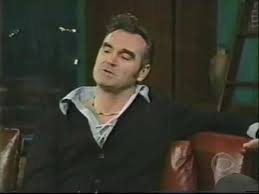
9. Wrestle with Russell (2009) 


Irresistible and iconic! In what can only be described as a stunning work of art - a masterpiece, if you will - Russell's interview with Morrissey is my all-time favourite. Just look at the captured image above - seeing Morrissey laugh like this warms the heart. Rapid-fire witty discourse ensues and Russell expresses that Morrissey isn't always the easiest interviewee as he "doesn't answer questions very directly, darling." Saying something different and the art of not being formatted follow, and the conversation flows from the desire to flee reality of life in 1970's Manchester, to hairstyles, to cliches. The two vegetarians discuss animal rights: "animals look to us for protection." They also talk about making the mundane poetic, people as art, and being loved and despised as an open, forceful person. The interview finishes as Russell serenades us, wearing an oh-so-alluring and "fetching cardigan".

Part 1: https://www.youtube.com/watch?v=N1GRRZegHow
Part 2: https://www.youtube.com/watch?v=2A6CK5g7Lws


10. Larry King (2015)


A radiant and bejeweled Morrissey meets with Larry King at Bootsy Bellows on Sunset Blvd. They begin their chat with the Smiths, the Mexican fanbase, and Moz talks about how he has always wanted to be himself in an industry that doesn't normally allow people to do that. Morrissey describes his "chattering mind" and his sensitivity. He discusses his health, veganism, touring, and politics. The second part of the interview includes fan questions from social media. One question in particular moves me deeply, as Morrissey is asked about his depression: he says it is "usually the very first thing when you wake up... there is no cure... it's part of being a sensitive, open human... it's a frame of mind, a state of mind, and it's circumstantial mostly." Larry asks Moz about suicide, to which he replies, "It crosses everybody's mind... even people who mistakenly assume they are happy... it's taking control and saying no more... and it's admirable." After the interview, Morrissey sings Kiss Me A Lot.

https://www.youtube.com/watch?v=4vKBu3-jecM&t=1235s


Honourable Mentions:

I've decided to choose 2 videos for my selection of honourable mentions.  The first one was the write-in darling of the Twitter Poll I made.  The results of the poll are as follows:


1. Jools Holland (2004)


Morrissey's 2004 interview on Jools Holland was the most popular one not listed in the poll. The obvious highlight for me (being entirely phobic of visitors) is "No Jools, I refuse to open the door."

https://www.youtube.com/watch?v=3emBbAEuXY4


2. The One Show (2009)


Obviously, no one voted for The One Show appearance as it's deeply steeped in the land of awkwardness. However, I like watching it because I see this as a perfect example of how Morrissey stands out against the bland, crashing bores of the world; he actually says something about me to my life in this desert of soullessness! The statement "I couldn't think of a job I wanted to do, so I thought I shouldn't do any" seems to palpably rattle the interviewers. Another highlight is when Adrian Chiles, who seems perpetually confused, bumbles and stumbles his way through a perplexingly out-of-touch comment about how "We'd all have to sympathize with the white collar workers, who have only ever really enjoyed success..." WHAT?! Moz weighs in, "Therefore, why sympathize with them" and you have to love him for it. I do feel for Moz here though, as he looks generally uncomfortable for much of the interview.


https://www.youtube.com/watch?v=yiwhwuRBmk4&t=50s


I'll leave you with this photo, just posted today on Jesse Tobias' instagram: Morrissey in Rome:

via 8stitches9lives on Instagram

Forever Handsome in Rome